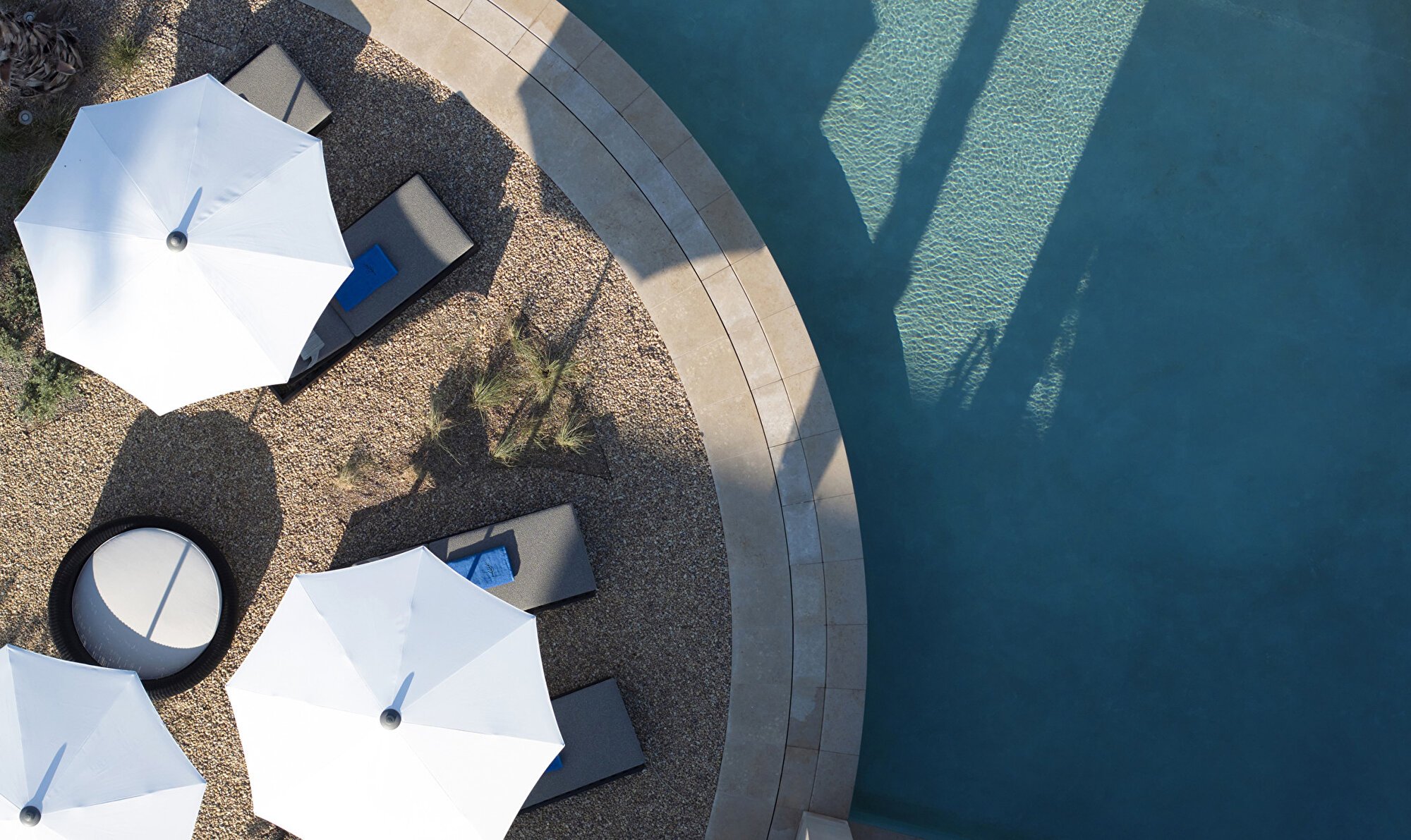
Glatz Swiss Parasols · FIM Italian Shade · Canada & USA
Premium Shade Solutions for Golf & Country Clubs
Protect your outdoor dining revenue, extend your season, and give members the standard of comfort they expect — with commercial shade systems engineered to perform where standard umbrellas fail.
The Challenge
Outdoor weather shouldn't decide how much revenue your club earns.
Golf and country clubs operate at a premium standard. Their outdoor spaces — dining terraces, pool decks, event lawns — need infrastructure to match. For General Managers and F&B Directors, unprotected outdoor space is a direct revenue risk.
Wind damage and member safety liability
Standard commercial umbrellas invert or topple in sudden gusts — damaging property and creating incidents on a busy patio. Golf courses are among the most wind-exposed outdoor dining environments in existence.
Lost outdoor F&B revenue
A single afternoon storm can empty a terrace that seats forty covers. Clubs without reliable shade lose thousands per weather event — revenue that doesn't roll over to next week.
A season that ends too early
Without protection from heat, UV, and autumn rain, clubs lose weeks of viable outdoor dining at both ends of the season. The right shade system extends your billing days significantly.
Aesthetics that undermine the club standard
Off-the-shelf umbrellas in mismatched colours visually compromise a property that members and guests judge from the first glance. Your shade should feel designed for the space, not placed in it.
Our Solutions
Swiss engineering. Italian design. Built for clubs that don't compromise.
We represent two of Europe's most respected commercial shade manufacturers — Glatz of Switzerland and FIM of Italy. Between them, they cover every application a golf or country club will encounter.
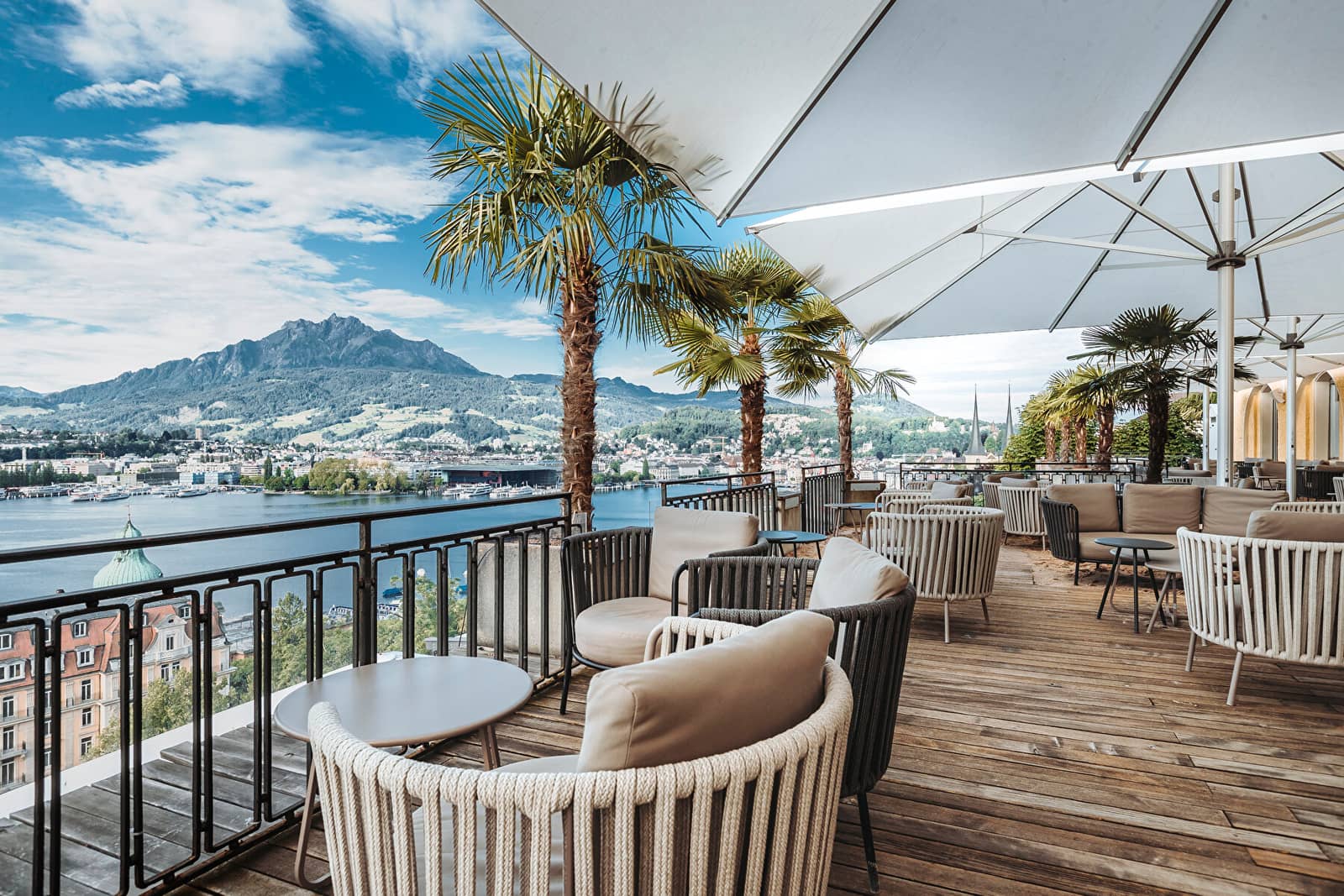
Glatz Swiss Parasols
Giant commercial parasols. Wind-certified to 115 km/h.
Glatz has engineered outdoor shade in Switzerland since 1895. Their F-Line and Palazzo series are the benchmark for wind-rated commercial patio umbrellas in Europe and North America — specified by five-star resorts, Michelin-starred restaurant terraces, and members-only clubs where aesthetics and liability are both non-negotiable. Canopies extend up to 5×5 metres under a single elegant mast, covering eight to twelve covers without central column interruption. Every Glatz wind rating is independently verified in a certified aerodynamic wind tunnel — the same rigorous methodology used in automotive and aviation structural testing. On exposed links courses and coastal club properties, the Castello Pro's 115 km/h rating isn't a luxury: it's an operational requirement.
- Castello Pro rated to 115 km/h — the benchmark for exposed coastal and links sites
- Palazzo Royal covers up to 5×5 m under a single elegant mast
- Fortero Pro and Fortello Pro close over tables — no furniture relocation required
- Flat-roof aerodynamic geometry sheds wind pressure instead of catching it
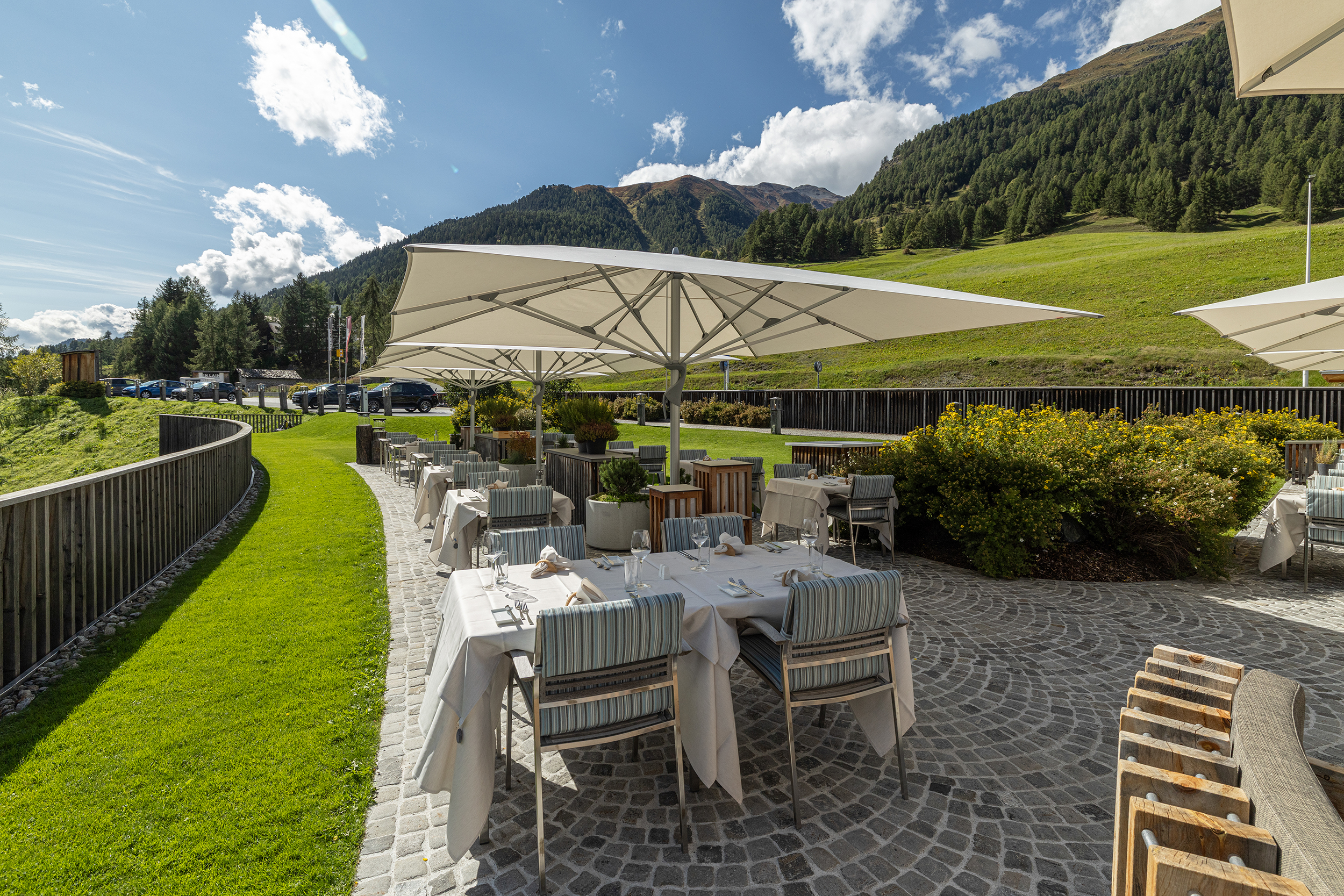
FIM Italian Shade Systems
Commercial cantilever and umbrella systems for every space on the property.
Founded in 1957, FIM manufactures their Capri and Ischia cantilever series exclusively for commercial hospitality markets. Unlike consumer-grade products, every FIM unit is built with commercial-grade welded steel frames, reinforced fabric-to-arm anchor points, and a heavy-duty crank system engineered for daily operation by front-of-house staff. The offset cantilever design positions the support mast entirely outside the dining footprint — letting your tables sit directly under the canopy with no post interrupting covers, service flow, or sightlines. The Capri's 360° rotation lets your team track the sun through a full service period without moving a single chair. For established club properties with irregular terrace layouts inherited from historic architecture, the Ischia's modular sizing in round, square, and hexagonal footprints provides coverage solutions that standard rectangular umbrellas cannot.
- Capri P17 and P19 offset cantilever — up to 400 cm canopy with no post in the dining zone
- Ischia series in round, square, and hexagonal for modular and irregular terrace layouts
- 360° rotation on all cantilever models — staff adjust shade through the day without tools
- Commercial powder-coated frames in multiple finishes matched to club colour palettes
Why Golf Clubs Choose CSC Shade
A shade partner that understands what your members expect.
We've worked with golf and country clubs from Vancouver Island to the Maritimes — and with resort properties across the continental United States. In that work, a consistent picture has emerged: most clubs have already tried standard commercial-grade patio umbrellas. Most have already had a bad experience — a canopy that inverted in a summer storm, a fabric that faded to pale grey in a single season, a frame that rusted through its warranty. The difference between a club that tolerates its outdoor space and one that generates revenue from it usually comes down to one decision: the quality of the shade infrastructure they committed to.
Our products come from Glatz of Switzerland and FIM of Italy — the same manufacturers supplying five-star resort terraces and Michelin-rated outdoor dining rooms across Europe. They are not sold at trade shows. They are not comparable to anything available through standard hospitality supply channels. They are engineered specifically for the environments where standard products fail.
- Wind-certified structural performance from 55 to 115 km/h — model-dependent, independently tested
- Canopy sizes up to 5×5 m — full dining bay coverage without midpoint column obstructions
- Solution-dyed Sunbrella fabric: colourfast for 10+ years, UPF 50+, water column rated
- Custom frame finishes and fabric selections to match your club's architecture and palette
- Weighted and in-ground base options — preserve premium stonework, composite decking, rooftop membranes
- Fabric panels remove seasonally in minutes; structural frame stays in place year-round
- Ships from British Columbia — serving clubs across Canada and continental USA
Technical Performance
Engineered for conditions that end the season at other clubs.
Every model below ships with independently verified structural ratings — not marketing estimates. We recommend specific systems based on your site's wind exposure, terrace dimensions, and aesthetic brief.
| Model | Type | Max Canopy Size | Wind Rating | Best Application |
|---|---|---|---|---|
| Glatz Palazzo Royal | Giant centre-pole parasol | Up to 500×500 cm | Engineered for contract use | Main terrace, event lawn, marquee dining |
| Glatz Castello Pro | Heavy-duty centre-pole | Ø 200 – 600 cm | Up to 115 km/h (11 Bft) | Exposed coastal and links course sites |
| Glatz Fortello Pro | Side-mast, sq / rectangular | 350×350 – 400×300 cm | Up to 80 km/h (9 Bft) | Poolside lounge, grill patio, evening venue |
| Glatz Fortero Pro | Side-mast, round / rect. | Ø 350 – 350×250 cm | Up to 70 km/h (8 Bft) | Main restaurant patio, course-view dining |
| FIM Capri Series | Commercial cantilever | Ø 290 – 400 cm | Commercial grade | Pool deck, covered cart staging, starter area |
| FIM Ischia Series | Cantilever, multiple shapes | Ø 280 – 340 cm | Commercial grade | Modular patio coverage, irregular layouts |
Wind ratings reflect Beaufort Force wind tunnel testing. All Glatz models feature solution-dyed Sunbrella fabric at 300 g/m² with UPF 50+ as standard. Custom fabric grades and LED lighting available on request.
Frequently Asked Questions
Common questions from club managers and F&B directors.
What shade systems are optimized for driving range tee-lines to prevent swing obstructions?
Golf driving ranges require completely unobstructed spaces to ensure player safety and comfort. Cantilever shade structures are ideal, as their supporting columns are positioned entirely behind the player line while the canopy projects forward over the tee boxes. This design provides golfers with maximum elbow room and clear sightlines to track ball flight without column interference.
How can country clubs incorporate custom branding and signature color schemes?
Maintaining a cohesive, high-end aesthetic is vital for private country clubs. Both Glatz and FIM offer extensive customization, including over 70 fabric colors and specialized powder-coated frame finishes matched to standard RAL codes. Clubs can select traditional forest greens or deep navy blues to match their branding, and specify custom-embroidered logos on parasol valances for a bespoke look.
What structural wind-load codes must golf course shade systems satisfy?
Because golf courses are vast, open landscapes with minimal wind-breaking structures, shade installations face extreme wind exposure. To ensure safety, permanent structures should meet stringent Risk Category III structural standards, certifying they can withstand winds up to 120 mph. Support columns must use high-tensile steel or heavy-duty aluminum tubing meeting ASTM A-500 standards with a minimum yield strength of 40,000 psi.
How do strategically placed course rest areas improve member experience and pace of play?
Placing shaded rest areas near the greens and tee boxes of the back nine holes gives players a cool, dry place to recover during hot midday play. Keeping members comfortable prevents fatigue, which helps maintain an optimal pace of play and directly encourages longer member stays. This simple amenity also naturally increases food, beverage, and pro shop sales.
What lighting and glare standards are required for driving ranges and clubhouse patios?
Evening driving ranges require precise lighting to ensure ball visibility without causing blinding glare. Integrated LED systems should deliver a daylight-replicating color temperature of 4000K to 5000K and a high uniformity level of 0.5 to 0.7. Fixtures must feature directional shielding to prevent light spill from bleeding into adjacent fairways or surrounding neighborhoods.
How do outdoor shade structures protect and preserve valuable golf cart fleets?
Continuous solar exposure degrades golf cart fleets, causing plastic body panels to fade, vinyl seats to crack, and electronic systems to overheat. Shading cart staging and storage zones lowers the surface temperature of the vehicles and keeps steering wheels cool. More importantly, it protects onboard battery systems from heat-induced charge degradation, extending the operational lifespan of your fleet.
How should a country club's emergency risk management plan handle lightning hazards?
Because golf course shelters and driving range structures are located in open, exposed areas, they require clear severe weather safety policies. During active lightning, open aluminum or steel shade structures can act as ground paths, presenting a severe shock hazard. The club's risk management plan must mandate immediate evacuation of all open shelters when lightning is detected within a 10-mile radius, directing golfers to the fully grounded main clubhouse.
Start a Conversation
Tell us about your club.
We reply within one business day with product recommendations tailored to your space. No obligation.